Real Heroes of Indiaभारत के असली नायक · Fellow of the Royal Society, 1918फ़ेलो ऑफ़ द रॉयल सोसाइटी, 1918
Srinivasa Ramanujanश्रीनिवास रामानुजन
Kumbakonam, Madras and Cambridge, 1887–1920कुंभकोणम, मद्रास और कैम्ब्रिज, 1887–1920
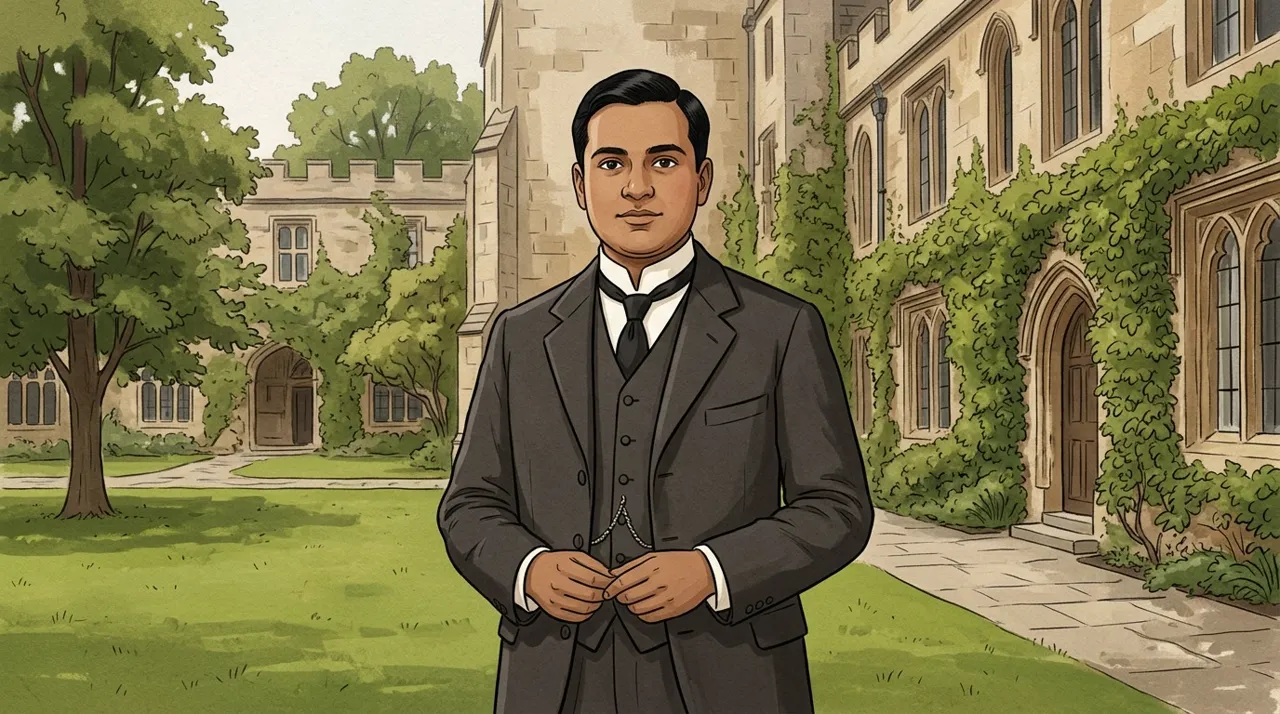
This is the story of Srinivasa Ramanujan, a boy from a small temple town in Tamil Nadu who became one of the greatest mathematicians the world has ever known.
यह कहानी है श्रीनिवास रामानुजन की, जो तमिलनाडु के मंदिरों वाले एक छोटे-से शहर के लड़के थे, और बड़े होकर दुनिया के सबसे महान गणितज्ञों में से एक बने।
Ramanujan was born in 1887 and grew up in Kumbakonam, in a poor family. His mother sang devotional songs at the temple. At school, he loved numbers more than anything.
रामानुजन का जन्म 1887 में हुआ, और वे कुंभकोणम में एक ग़रीब परिवार में बड़े हुए। उनकी माँ मंदिर में भजन गाती थीं। स्कूल में उन्हें सबसे ज़्यादा प्यार अंकों से था।
At about sixteen, he borrowed an English book by G. S. Carr, full of about five thousand maths results. Ramanujan worked through them alone, then began finding new ones of his own. Paper was costly, so he often worked on a slate.
लगभग सोलह साल की उम्र में उन्होंने जी. एस. कार की एक अंग्रेज़ी किताब उधार ली, जिसमें गणित के लगभग पाँच हज़ार नतीजे थे। रामानुजन ने अकेले बैठकर उन्हें हल किया, और फिर ख़ुद नए नतीजे खोजने लगे। काग़ज़ महँगा था, इसलिए वे अक्सर स्लेट पर हिसाब लगाते थे।
He won a scholarship to college, but he studied only maths. He failed his other subjects and lost the scholarship. Without a degree, and often hungry, he kept going.
उन्हें कॉलेज के लिए छात्रवृत्ति मिली, पर वे सिर्फ़ गणित पढ़ते रहे। वे बाक़ी विषयों में फ़ेल हो गए और छात्रवृत्ति छिन गई। न डिग्री थी, अक्सर भरपेट खाना भी नहीं, फिर भी वे लगे रहे।
In 1912, he became a clerk at the Madras Port Trust, where his colleagues encouraged him. In January 1913, he wrote to G. H. Hardy, a famous mathematician at Cambridge University in England, and sent him pages full of formulas.
1912 में वे मद्रास पोर्ट ट्रस्ट में क्लर्क बन गए, जहाँ उनके साथियों ने उनका हौसला बढ़ाया। जनवरी 1913 में उन्होंने इंग्लैंड की कैम्ब्रिज यूनिवर्सिटी के मशहूर गणितज्ञ जी. एच. हार्डी को चिट्ठी लिखी, और साथ में सूत्रों से भरे पन्ने भेजे।
At first, Hardy wondered if it was a trick. But some of the results, he said later, "defeated me completely". He decided that this clerk was a genius, and invited him to Cambridge. In March 1914, Ramanujan sailed for England.
पहले तो हार्डी को लगा कि कहीं यह कोई चालाकी तो नहीं। पर उन्होंने बाद में कहा कि कुछ नतीजों ने उन्हें "पूरी तरह हरा दिया"। उन्होंने तय किया कि यह क्लर्क एक प्रतिभाशाली गणितज्ञ है, और उसे कैम्ब्रिज बुलाया। मार्च 1914 में रामानुजन जहाज़ से इंग्लैंड के लिए निकल पड़े।
In Cambridge, Ramanujan and Hardy worked together for about five years. One discovery was about partitions, the ways of breaking a number into smaller whole numbers. The number 4 has five: 4, 3+1, 2+2, 2+1+1 and 1+1+1+1. In 1918, Ramanujan became a Fellow of the Royal Society, only the second Indian so honoured.
कैम्ब्रिज में रामानुजन और हार्डी ने लगभग पाँच साल साथ काम किया। उनकी एक खोज "पार्टीशन" के बारे में थी, यानी किसी संख्या को छोटी पूर्ण संख्याओं के जोड़ में तोड़ने के तरीक़े। संख्या 4 के पाँच तरीक़े हैं: 4, 3+1, 2+2, 2+1+1 और 1+1+1+1। 1918 में रामानुजन फ़ेलो ऑफ़ द रॉयल सोसाइटी बने। यह सम्मान पाने वाले वे सिर्फ़ दूसरे भारतीय थे।
But England's cold winters and wartime food shortages were hard on him, and he fell seriously ill. Once, Hardy came to visit and said his taxi's number, 1729, seemed a dull one. "No," Ramanujan replied, "it is a very interesting number." It is the smallest number made by adding two cubes in two different ways: 1×1×1 + 12×12×12, and 9×9×9 + 10×10×10.
पर इंग्लैंड की ठंडी सर्दियाँ और युद्ध के समय खाने की कमी उनके लिए मुश्किल थीं, और वे बहुत बीमार पड़ गए। एक बार हार्डी उनसे मिलने आए और बोले कि उनकी टैक्सी का नंबर, 1729, बड़ा मामूली-सा लगा। रामानुजन ने कहा, "नहीं, यह तो बहुत दिलचस्प संख्या है।" यह वह सबसे छोटी संख्या है जो दो घनों को जोड़कर दो अलग-अलग तरीक़ों से बनती है: 1×1×1 + 12×12×12, और 9×9×9 + 10×10×10।
In 1919, still unwell, Ramanujan returned to India. He died in April 1920, aged only 32, working on new ideas until the end. Mathematicians still study his notebooks, and India celebrates his birthday, 22 December, as National Mathematics Day. His story reminds us that curiosity and hard work can open doors, wherever we start.
1919 में, बीमारी की हालत में ही, रामानुजन भारत लौट आए। अप्रैल 1920 में, सिर्फ़ 32 साल की उम्र में, उनका निधन हो गया। आख़िरी दिनों तक वे नए विचारों पर काम करते रहे। गणितज्ञ आज भी उनकी कॉपियों का अध्ययन करते हैं, और भारत उनका जन्मदिन, 22 दिसंबर, राष्ट्रीय गणित दिवस के रूप में मनाता है। उनकी कहानी हमें सिखाती है कि हम कहीं से भी शुरू करें, जिज्ञासा और मेहनत से रास्ते खुल सकते हैं।
Quick factsमुख्य तथ्य
- Born: 22 December 1887, Erode (then Madras Presidency, now Tamil Nadu); grew up in Kumbakonamजन्म: 22 दिसंबर 1887, इरोड (तब मद्रास प्रेसीडेंसी, अब तमिलनाडु); बचपन कुंभकोणम में बीता
- Self-taught: from about 1903, using G. S. Carr's book "A Synopsis of Elementary Results in Pure and Applied Mathematics"; lost his college scholarship and left college without a degreeख़ुद से पढ़ाई: लगभग 1903 से, जी. एस. कार की किताब "ए सिनॉप्सिस ऑफ़ एलिमेंट्री रिज़ल्ट्स इन प्योर एंड अप्लाइड मैथमैटिक्स" से; कॉलेज की छात्रवृत्ति छिन गई और बिना डिग्री के कॉलेज छूट गया
- Work: clerk at the Madras Port Trust from 1 March 1912; wrote to G. H. Hardy at Cambridge on 16 January 1913नौकरी: 1 मार्च 1912 से मद्रास पोर्ट ट्रस्ट में क्लर्क; 16 जनवरी 1913 को कैम्ब्रिज के जी. एच. हार्डी को चिट्ठी लिखी
- Cambridge: sailed from Madras on 17 March 1914; worked with Hardy for about five years; Bachelor of Arts by Research, March 1916कैम्ब्रिज: 17 मार्च 1914 को मद्रास से जहाज़ से रवाना; लगभग पाँच साल हार्डी के साथ काम किया; मार्च 1916 में शोध के आधार पर बी.ए. की डिग्री
- Honours: Fellow of the Royal Society (2 May 1918), only the second Indian; Fellow of Trinity College, Cambridge (October 1918), the first Indian; his birthday has been National Mathematics Day since 2012सम्मान: फ़ेलो ऑफ़ द रॉयल सोसाइटी (2 मई 1918), ऐसे सिर्फ़ दूसरे भारतीय; ट्रिनिटी कॉलेज, कैम्ब्रिज के फ़ेलो (अक्टूबर 1918), पहले भारतीय; 2012 से उनका जन्मदिन राष्ट्रीय गणित दिवस के रूप में मनाया जाता है
- Died: 26 April 1920, Madras (now Chennai), aged 32, about a year after returning to Indiaनिधन: 26 अप्रैल 1920, मद्रास (अब चेन्नई), 32 वर्ष की आयु में, भारत लौटने के लगभग एक साल बाद
Sources differ on several points. How he got Carr's book: one account says he borrowed a library copy from a friend, another that a student lodging with the family showed it to him; the story only says he borrowed it, at about sixteen. On college, some accounts say he failed the First Arts exam twice (1906 and 1907), others mention one attempt; the story just says he failed his other subjects. The cause of his illness in England is still debated: he was treated mostly for tuberculosis, but cancer, vitamin deficiency, lead poisoning and, in a 1994 study of his symptoms, hepatic amoebiasis (a liver infection that was curable at the time) have all been suggested; the story does not name an illness. He died in Madras, at a house in Chetput, according to the Oxford Dictionary of National Biography and others, though some biographies (and MacTutor's summary) say Kumbakonam. Some sources give his age at his Royal Society election as 31; he was 30. The Trinity fellowship date is given as 10 or 13 October 1918. The 1729 story comes from Hardy's own account; mathematicians later found 1729 in one of Ramanujan's notebooks written years earlier, and the number had been noted as far back as 1657. Ramanujan was devout and credited his gifts to his family goddess, Namagiri of Namakkal; a well-known family story says his mother dreamed that the goddess told her not to stop him going to England. These are matters of faith and family memory; Hardy thought him less devout than others did, and the mathematician Bruce Berndt points out that Ramanujan carefully recorded his results. The story leaves the legends out. The National Mathematics Day was announced in December 2011, for his 125th birth anniversary, and first observed on 22 December 2012.कई बातों पर स्रोत अलग-अलग हैं। कार की किताब उन्हें कैसे मिली: एक विवरण के अनुसार एक दोस्त ने लाइब्रेरी की किताब दी, दूसरे के अनुसार घर में किराए पर रहने वाले एक छात्र ने दिखाई; कहानी बस इतना कहती है कि उन्होंने लगभग सोलह साल की उम्र में किताब उधार ली। कॉलेज के बारे में कुछ स्रोत कहते हैं कि वे फ़र्स्ट आर्ट्स परीक्षा में दो बार (1906 और 1907) फ़ेल हुए, कुछ एक ही बार का ज़िक्र करते हैं; कहानी बस यह कहती है कि वे बाक़ी विषयों में फ़ेल हुए। इंग्लैंड में उनकी बीमारी की असली वजह पर आज भी बहस है: उनका इलाज ज़्यादातर टीबी का हुआ, पर कैंसर, विटामिन की कमी, सीसे का ज़हर, और 1994 के एक अध्ययन के अनुसार जिगर का अमीबा संक्रमण (जो उस समय ठीक हो सकता था), ये सब वजहें बताई गई हैं; कहानी किसी बीमारी का नाम नहीं लेती। ऑक्सफ़र्ड डिक्शनरी ऑफ़ नेशनल बायोग्राफ़ी और दूसरे स्रोतों के अनुसार उनका निधन मद्रास में, चेटपट के एक घर में हुआ, हालाँकि कुछ जीवनियों में (और मैकट्यूटर के सारांश में) कुंभकोणम लिखा है। कुछ स्रोत रॉयल सोसाइटी में चुने जाने के समय उनकी उम्र 31 बताते हैं; असल में वे 30 साल के थे। ट्रिनिटी फ़ेलोशिप की तारीख़ 10 या 13 अक्टूबर 1918 बताई जाती है। 1729 वाला क़िस्सा ख़ुद हार्डी ने लिखा है; बाद में गणितज्ञों को 1729 रामानुजन की कई साल पुरानी एक कॉपी में भी मिला, और यह संख्या 1657 में भी दर्ज की जा चुकी थी। रामानुजन बहुत धार्मिक थे और अपनी प्रतिभा का श्रेय अपनी कुलदेवी, नामक्कल की नामगिरी, को देते थे; परिवार में एक मशहूर क़िस्सा है कि उनकी माँ ने सपना देखा कि देवी ने उनसे कहा, बेटे को इंग्लैंड जाने से मत रोको। ये आस्था और पारिवारिक यादों की बातें हैं; हार्डी उन्हें उतना धार्मिक नहीं मानते थे जितना दूसरे लोग, और गणितज्ञ ब्रूस बर्नड्ट बताते हैं कि रामानुजन अपने नतीजे बहुत ध्यान से लिखते थे। कहानी में ये किंवदंतियाँ शामिल नहीं की गईं। राष्ट्रीय गणित दिवस की घोषणा दिसंबर 2011 में, उनकी 125वीं जयंती पर, हुई, और यह पहली बार 22 दिसंबर 2012 को मनाया गया।
Worksheetवर्कशीट · Srinivasa Ramanujan · Classes 3 to 5कक्षा 3 से 5
Name / नाम: ____________________Class / कक्षा: ______Date / तारीख़: __________
- What did Ramanujan often use to do his sums, because paper was costly?काग़ज़ महँगा था, इसलिए रामानुजन अक्सर हिसाब लगाने के लिए किस चीज़ का इस्तेमाल करते थे?
- Who did Ramanujan write a letter to in 1913? What happened after that?1913 में रामानुजन ने किसे चिट्ठी लिखी? उसके बाद क्या हुआ?
- Ramanujan failed in college but did not give up. How do you think he felt? What helped him keep going?रामानुजन कॉलेज में फ़ेल हुए, पर उन्होंने हार नहीं मानी। आपके विचार से उन्हें कैसा लगा होगा? किस चीज़ ने उन्हें आगे बढ़ते रहने में मदद की?
Activityगतिविधि
Draw the moment from the story you remember most. Then complete: "My role model is ____. The values I have learnt from their life are ..." (about 150 words)
कहानी का वह पल बनाइए जो आपको सबसे ज़्यादा याद है। फिर पूरा कीजिए: "मेरे आदर्श हैं ____। उनके जीवन से मैंने ये मूल्य सीखे हैं ..." (लगभग 150 शब्द)
Worksheetवर्कशीट · Srinivasa Ramanujan · Classes 6 to 8कक्षा 6 से 8
Name / नाम: ____________________Class / कक्षा: ______Date / तारीख़: __________
- Check the 1729 story yourself: work out 1×1×1 + 12×12×12 and 9×9×9 + 10×10×10. Then find all the partitions of the number 5. How many are there?1729 वाले क़िस्से को ख़ुद जाँचिए: 1×1×1 + 12×12×12 और 9×9×9 + 10×10×10 का हिसाब लगाइए। फिर संख्या 5 के सारे पार्टीशन लिखिए। कुल कितने हैं?
- Ramanujan was brilliant at maths but failed his other subjects. Should schools let a student who is very good at one subject focus on it? Give reasons for both sides.रामानुजन गणित में कमाल के थे, पर बाक़ी विषयों में फ़ेल हुए। क्या स्कूलों को किसी एक विषय में बहुत अच्छे छात्र को उसी पर ध्यान देने देना चाहिए? दोनों पक्षों के तर्क दीजिए।
- Imagine you are Ramanujan in 1913. Write a short letter to a famous scientist explaining what you have discovered and why you need help.कल्पना कीजिए कि आप 1913 के रामानुजन हैं। किसी मशहूर वैज्ञानिक को एक छोटी चिट्ठी लिखिए, जिसमें बताइए कि आपने क्या खोजा है और आपको मदद क्यों चाहिए।
Activityगतिविधि
Write a paragraph of about 300 words: "My role model is ____. The values I have learnt from their life are ..." or plan a one-minute storytelling video.
लगभग 300 शब्दों का अनुच्छेद लिखिए: "मेरे आदर्श हैं ____। उनके जीवन से मैंने ये मूल्य सीखे हैं ..." या एक मिनट के कहानी-वीडियो की योजना बनाइए।
Worksheetवर्कशीट · Srinivasa Ramanujan · Classes 9 to 12कक्षा 9 से 12
Name / नाम: ____________________Class / कक्षा: ______Date / तारीख़: __________
- Two British professors returned Ramanujan's papers without comment before Hardy replied. What does this tell us about how talent is recognised, and who might still be missed today?हार्डी के जवाब से पहले दो ब्रिटिश प्रोफ़ेसरों ने रामानुजन के पन्ने बिना कुछ कहे लौटा दिए थे। इससे प्रतिभा की पहचान के बारे में क्या पता चलता है, और आज भी किन लोगों की प्रतिभा अनदेखी रह सकती है?
- Doctors and historians still disagree about what illness Ramanujan had. How can historians study a medical question a hundred years later, and how sure can they be?डॉक्टर और इतिहासकार आज भी इस पर एकमत नहीं हैं कि रामानुजन को कौन-सी बीमारी थी। सौ साल बाद इतिहासकार किसी बीमारी के सवाल का अध्ययन कैसे कर सकते हैं, और वे कितने पक्के हो सकते हैं?
- Ramanujan relied on intuition; Hardy insisted on proof. Why does mathematics need both? Use the story of their partnership in your answer.रामानुजन अपनी अंतर्दृष्टि पर भरोसा करते थे; हार्डी सबूत, यानी प्रमाण, पर ज़ोर देते थे। गणित को दोनों की ज़रूरत क्यों है? अपने जवाब में उनकी साझेदारी की कहानी का इस्तेमाल कीजिए।
Activityगतिविधि
Write an essay of about 750 words: "____ changed the lives of many people. If given a chance to carry their work forward, I would like to ..."
लगभग 750 शब्दों का निबंध लिखिए: "____ ने बहुत से लोगों का जीवन बदला। अगर मुझे उनके काम को आगे बढ़ाने का मौका मिले, तो मैं ..."